
What Changes When You Inherit a Gemstone With No Paperwork

A ring arrives, or a loose stone in a twist of tissue at the back of a drawer, and with it comes a small, unsettling silence. There is no report. No invoice. No letter explaining where it came from or what it is. Someone in the family always said the green stone was an emerald, or that the blue one came from Ceylon, but the person who knew for certain is gone, and what remains is a beautiful object and a set of questions you did not ask to inherit. This is one of the most common situations I am asked about, and the anxiety it produces is almost always greater than the situation deserves.
In One Minute |
Inheriting a fine stone with no documentation is far more common than people expect, and the absence of paperwork is not a verdict on the stone. A great many genuine, valuable stones have passed through families with no report simply because lab documentation was never routine in earlier decades. What the absence changes is the starting point, not the outcome: rather than reading a stone's history, you establish it. The most valuable single step is usually a current report from a respected laboratory, which can confirm what the stone is and how it has been treated. Family memory and old photographs add useful context but cannot substitute for examination. The right first move is unhurried: protect the piece, gather whatever scraps of history exist, and have the stone looked at before you make any decision about insuring, selling, or resetting it. |
The Absence of Paperwork Is Not a Verdict
The first thing worth saying plainly is that a missing paper trail tells you very little about the stone itself. For most of the last century, a private buyer acquiring a fine gem received a stone and perhaps a handwritten receipt, nothing more. Independent laboratory reports as we know them today became common far more recently than most people assume. So a sapphire bought in the 1970s, worn for fifty years, and passed down with no certificate is behaving exactly as you would expect a stone of its era to behave. Its silence is generational, not suspicious.
This matters because the instinct, on receiving an undocumented stone, is to assume the worst: that the absence of proof means the stone is not what the family believed, or that it is worth less for having no papers. Neither follows. A stone's quality lives in the stone. Documentation describes that quality; it does not create it. What you have inherited is not a problem to be solved but a stone to be understood, and understanding is a process with a clear and reassuring shape.
What You Cannot Know Yet — and What That Means
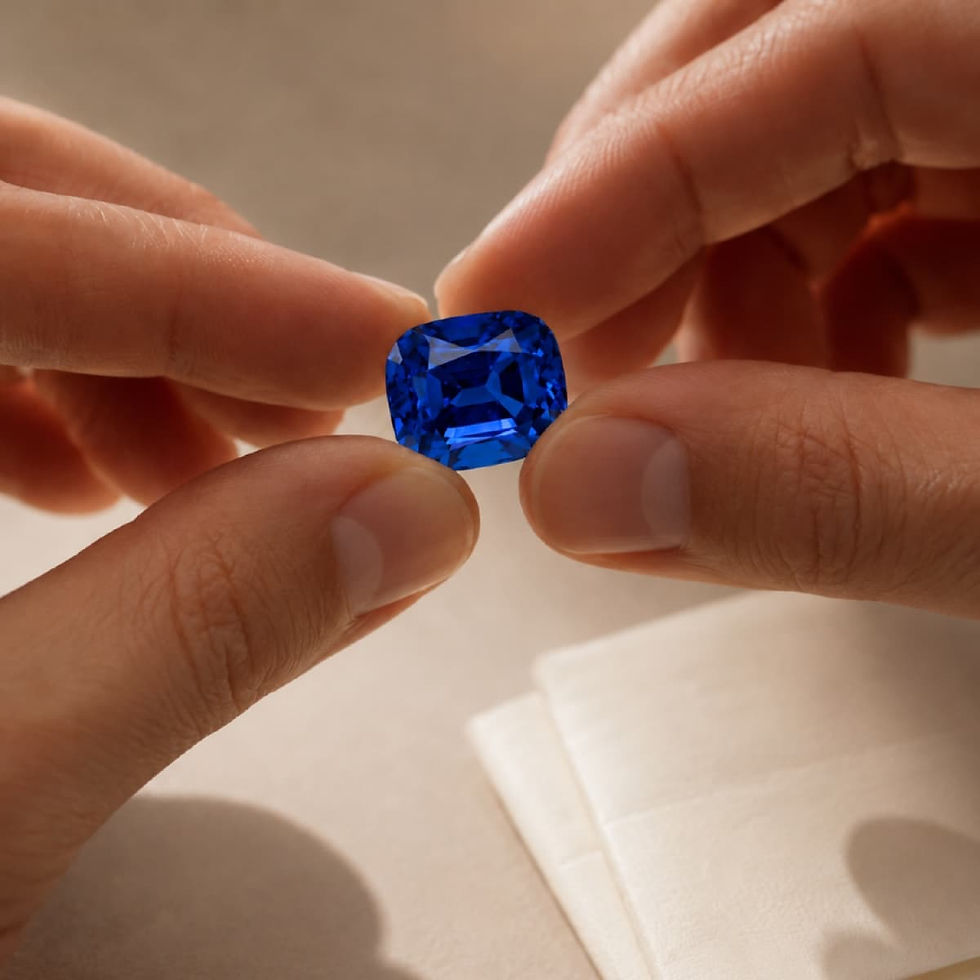
It is worth being honest about the genuine uncertainty, because false reassurance helps no one. Without examination, you cannot yet confirm what the stone is. A green stone the family called an emerald could be an emerald, or it could be a green tourmaline, a peridot, or something else entirely lovely but different. You cannot know how it has been treated, which for colored stones is one of the most consequential facts of all. And you cannot know its origin, the family lore about Ceylon or Burma notwithstanding, because origin is a determination made in a laboratory, not a memory passed across a dinner table.
None of this is cause for alarm. It is simply the map of what is currently unknown, and almost every item on it can be resolved. The point of naming the uncertainty is to convert a vague unease into a short list of answerable questions, which is a far more comfortable thing to hold.
The Single Most Valuable Step
If you do only one thing with an inherited stone of apparent significance, have it examined and, where warranted, submitted to a respected gemological laboratory for a current report. This one step resolves most of the uncertainty above at once. It confirms identity, so you know what you actually have. It discloses treatment, which is essential to understanding both value and care. And for stones where it matters and can be determined, it may offer an opinion on origin, turning family lore into something closer to fact.
A current report does something else worth naming: it gives the stone a documented starting point from this day forward. The history before you may be lost, but the history from here need not be. In a real sense, commissioning a report is the moment an undocumented stone re-enters the documented world, and everything you do with it afterward — insuring, gifting, resetting, eventually passing it on yourself — rests on that foundation.
For the broader question of what documentation does and does not establish, our guide on the role of provenance in collecting explains why a report reduces uncertainty rather than manufacturing value. And for reading the report once you have it, how to read a gemstone report walks through the fields in plain language.
What Family Memory Can and Cannot Do
The stories that come with an inherited stone are precious, and they are not worthless as evidence, but they must be held in proportion. A grandmother's certainty that a stone came from a particular place, or was bought on a particular trip, is genuine context. It can guide a laboratory's attention and it enriches the meaning of the piece immeasurably. What it cannot do is stand in for examination. Memory softens and embroiders across generations; the stone bought in Colombo becomes, three retellings later, the stone bought from a maharaja. This is not dishonesty. It is simply what stories do.
So gather the memories, write them down, find the old photographs in which the piece appears, keep any scrap of receipt or note. Treat all of it as valuable supporting context to sit alongside a report, never as a replacement for one. The combination of honest family history and current documentation is, in fact, a richer provenance than many newly purchased stones can claim.
The Calm First Steps When You Get a Gemtone With No Paperwork
When an undocumented stone of apparent significance comes into your hands, the sequence that serves people best is unhurried and simple.
Protect it first. Before anything else, store the piece safely and avoid cleaning it aggressively or having it altered. A stone's condition is part of its story, and well-meant interference can complicate later examination.
Gather what little history exists. Photographs, notes, receipts, and the recollections of older family members — collect them while you can, particularly while those who remember are still able to tell you.
Resist early decisions. Do not insure for a guessed value, sell, or reset the stone before you know what it is. Each of those decisions depends on facts you do not yet have.
Have it examined. A consultation with a specialist, followed where warranted by a current laboratory report, converts the unknown stone into a known one and tells you what your real options are.
For inherited jewelry more broadly — multiple pieces, mixed documentation, the practical and emotional weight of an estate — our cornerstone guide on what to do first with inherited jewelry sets out the wider sequence.
FAQs
Is an inherited gemstone with no paperwork worth less?
Not inherently. The absence of documentation is extremely common with inherited stones, because lab reports were not routine in earlier decades. A stone's value rests on what it actually is — its identity, quality, and treatment — not on whether papers happened to survive. Obtaining a current report typically resolves the uncertainty rather than revealing a problem.
What is the first thing I should do with an inherited stone?
Protect the piece and avoid altering, aggressively cleaning, or resetting it. Then gather whatever history exists — photographs, receipts, family recollections — and have the stone examined by a specialist before making any decision about insuring, selling, or resetting it.
Can a laboratory tell where my inherited stone came from?
For some stones, yes; for others, only cautiously or not at all. Origin is an expert opinion drawn from a stone's internal characteristics, offered with varying confidence depending on the stone. A respected laboratory can tell you whether your particular stone's origin can be credibly determined.
Should I trust the family story about the stone?
Family stories are valuable context and worth preserving, but they cannot substitute for examination. Memory shifts across generations, and details about origin or value are often embroidered over time. Record the stories, then have them confirmed against what a laboratory and a specialist can actually establish.
Do I need a report before insuring an inherited stone?
In most cases, yes. Insuring a stone for a guessed value is risky in both directions — under-insuring leaves you exposed, over-insuring wastes premium. A current report, paired with appropriate valuation documentation, gives an insurer the basis they typically require.
Can an undocumented stone ever regain a provenance?
In a sense, yes. While the history before you may be unrecoverable, a current laboratory report gives the stone a documented foundation from today forward. Combined with whatever family history you can preserve, this often produces a richer provenance than many newly bought stones carry.
Key Takeaways
A missing paper trail is generational, not suspicious — many genuine, valuable stones passed through families before lab reports were routine.
The absence of documentation changes your starting point, not the stone's quality; you establish its history rather than read it.
The single most valuable step is a current report from a respected laboratory, which confirms identity, discloses treatment, and re-enters the stone into the documented world.
Family memory is precious context but cannot replace examination; preserve the stories and confirm them.
An inherited stone with no paperwork is not a burden but an invitation — to look closely, to learn what you are holding, and to give a beautiful object the documented future its past was never granted. The silence it arrives with is not the end of its story. With a little patience, it is the beginning of the chapter you write.
If you have inherited a stone and are unsure what it is or what to do next, Caram offers private, unhurried consultations to help you understand the piece before any decision is made. Begin with a consultation · Learn about Caram valuations
About the Author
Rahul Jain is the seventh-generation Director of Caram and leads the family's work across rare emeralds, sapphires, rubies, and bespoke jewelry. He holds an MBA from the Tuck School of Business at Dartmouth and brings a background in finance and strategy to Caram's valuation practice. Rahul holds certifications from the Swiss Gemmological Institute (SSEF) and the Gübelin Academy, and regularly reviews lab reports from leading gemmological institutes as part of Caram's authentication and valuation work.
Rahul writes a quarterly letter for collectors and connoisseurs of fine colored gemstones. It explores rare stones, valuation, provenance, and the quiet art of choosing well — sent four times a year, no noise.


Comments